
Empty offices, slow permits, new fees: Boulder’s hard road for business
The city’s physical economy has been shrinking for years. City Hall’s answer has been more charges on the businesses that remain.
BOULDER, Colo. Late last year, Max Lord, who runs a construction business in Boulder, posted a video of himself driving through town and pointing at the “for lease” signs. It drew thousands of views. He told Denver7 the reason was simple: people could see old buildings disappearing and new ones sitting empty, and they wanted to know why.
The city’s own numbers suggest they’re right to ask.
Boulder built its reputation as a place where people start things. Today, a third of downtown office space sits unused, sales tax from the city’s physical shopping districts has fallen since before the pandemic, and business owners describe a permitting process that can cost them months. The city’s response has been new fees, most of them approved without a public vote.
A SHRINKING BASE
On paper, Boulder’s sales tax looks healthy. Collections grew from about $142 million in 2019 to about $174 million in 2024, according to city revenue reports compiled by PLAN-Boulder.
Nearly all of that growth came from online sales shipped into the city, which more than doubled, from $19.4 million to $40.2 million. Most of the places where people actually shop in Boulder went the other way. Sales tax from the downtown district fell 22 percent over those five years. North Broadway fell 19 percent, 29th Street 15 percent and Gunbarrel’s industrial area 16 percent, all before inflation. The Pearl Street Mall itself held roughly steady.
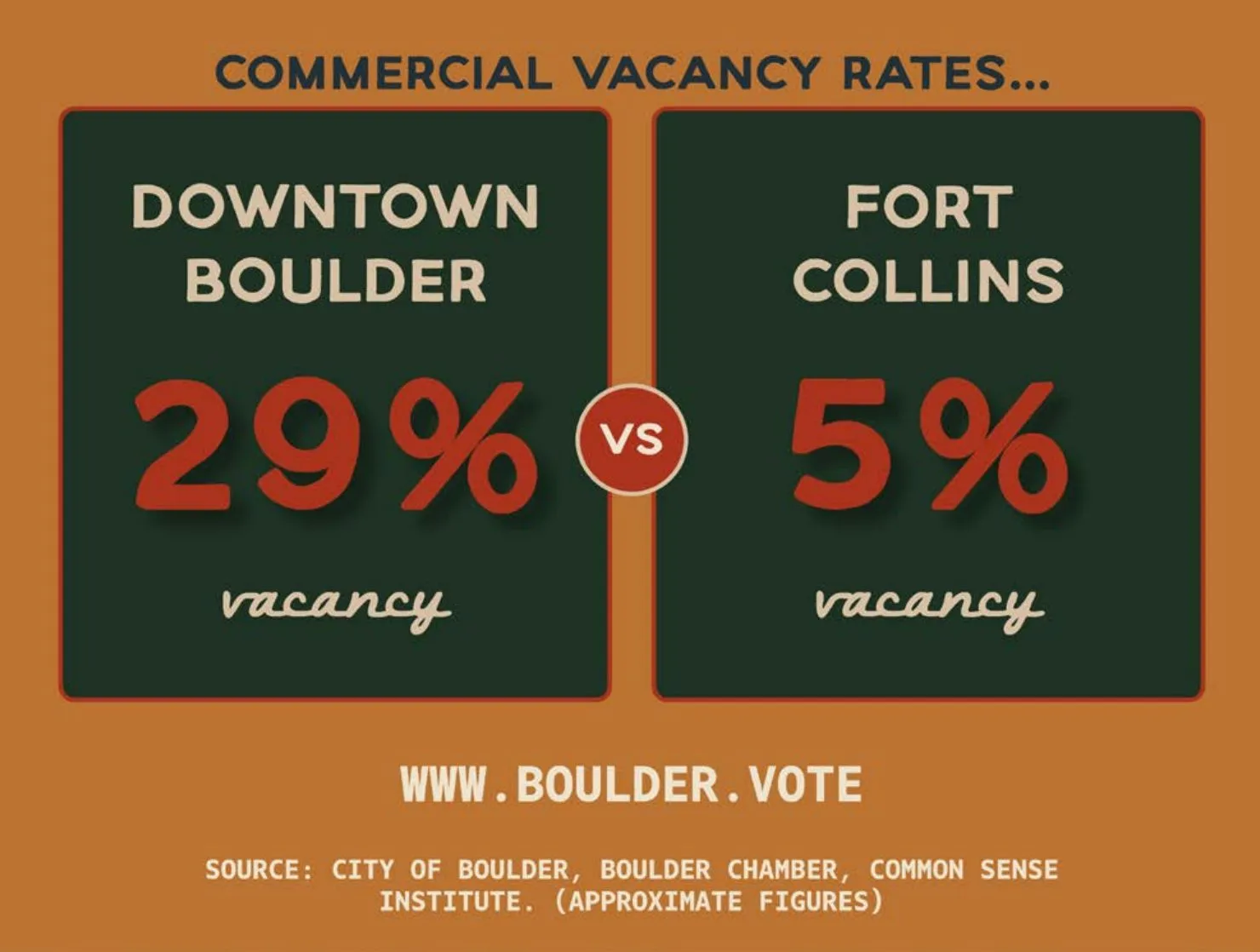
Office space is sitting empty as well. The city’s most recent economic indicator report put downtown office vacancy at 28.9 percent, a city spokesperson told Denver7. The Boulder Chamber’s economic council put it as high as 43 percent.
A SLOW FRONT DOOR
For a business trying to move into one of those empty spaces, the city is the first obstacle.
Boulder’s planning department posts its own targets: eight weeks for review of a new construction permit and five weeks for other work, and the clock starts only after the application is accepted as complete and the fees are paid. A local home builder, SoBo Homes, describes a longer reality: two to three weeks just to open a case, eight to 12 weeks for review, a resubmittal it says is almost always required, and another month before a permit is issued.
The Boulder Chamber says that delay is part of why downtown sits empty. Jonathan Singer, the chamber’s senior director of policy programs, told Denver7 that some of the city’s vacant offices are spaces tenants are waiting to occupy but can’t yet because of permitting, and that entrepreneurs face a rulebook as thick as a phone book.
FEES INSTEAD OF FIXES
As sales tax has flattened, the city has turned to charges that don’t require voter approval.
Last fall, the City Council voted 6-3 to create a transportation maintenance fee, billed to every property in the city starting next year. Commercial space will pay $160 per 1,000 square feet a year, and offices $71. Because it is a fee rather than a tax, the city says, it does not go to voters, and the council can adjust it every year. Councilmember Mark Wallach, who voted no, said some businesses didn’t know the fee was coming.
That fee is one of many. In its own guide to the November bond, the city lists what it has already done to balance its budget: higher parking rates in garages and on the street, and higher fees “across nearly every category and for every service” in Parks and Recreation.
A TOOL TURNED DOWN
This summer, business owners asked the council for something different: a downtown development authority, which would have steered future growth in downtown and University Hill tax revenue back into those districts to fill vacancies and support small businesses. Several spoke in favor at a public hearing.
“Some of our biggest problems, which is helping the small businesses and doing something about our vacancy spaces, can be helped with the DDA,” said Mayor Pro Tem Tara Winer.
The measure failed on a 4-4 vote in August. Mayor Aaron Brockett, Winer and Councilmembers Matt Benjamin and Rob Kaplan voted to send it to voters. Councilmembers Taishya Adams, Tina Marquis, Ryan Schuchard and Nicole Speer voted no.
COPY AND PASTE
Other cities, Singer noted, have already shown how to move faster. His prescription for Boulder: “a little bit of copy and paste with a little bit of Boulder innovation.”